Shower Problems
What Is Bathroom Silicone and What Is It Used For?
Learn where silicone belongs in a shower, how it differs from grout and waterproofing, and when recurring failure needs more than routine resealing.
What bathroom silicone does
Bathroom silicone is a flexible sealant used at junctions where tiled surfaces or different materials meet. In showers it commonly belongs at vertical corners, around the perimeter of a tiled floor or shower base, and where tiles meet glass, metal, ceramic, acrylic or polymarble fixtures.
These junctions can experience small amounts of movement. A suitable sanitary-grade silicone can flex with that movement while maintaining a neat, water-resistant finish. Its adhesion across different materials also makes it useful around showers, baths and basins.
Silicone, grout and waterproofing are different layers
Grout is a comparatively rigid finish used between tiles. Silicone is flexible, so it is normally used at changes of plane and perimeter joints where rigid grout is more likely to crack as the building or shower moves.
Neither product replaces the waterproofing system behind or beneath the tiles. Silicone seals a joint at the surface; grout fills the tile joints; waterproofing, drainage and correctly built substrates manage water within the shower assembly. Calling silicone a waterproof seal does not mean a bead of silicone can repair a failed membrane or damaged substrate.
- Grout: a rigid finish between tiles.
- Silicone: a flexible sealant at movement joints and material junctions.
- Waterproofing: a concealed system designed to protect the structure behind the finish.
Why shower silicone deteriorates
Shower silicone is exposed to frequent wetting, cleaning products, soap residue, temperature changes and movement. Over time it may discolour, become difficult to clean, develop mould, peel away or split. Heavily used showers can require maintenance sooner than lightly used ones, so there is no single replacement interval for every bathroom.
Surface mould does not automatically prove a concealed leak. Ventilation, drying time and cleaning all affect mould growth. However, mould or separation that quickly returns after replacement can be evidence that moisture, poor adhesion or movement is continuing at the joint.
When replacement is normal maintenance
Replacing deteriorated silicone can be appropriate maintenance when the joint is dry and stable and the waterproofing, substrate, shower base and drainage beneath it are sound. In that situation, renewing the finish restores the flexible surface seal.
Resealing should not be presented as a guaranteed cure for a leaking shower. If water is already affecting adjoining walls, floors or rooms, the visible silicone may be only one part of the evidence.
When recurring failure needs a rectification discussion
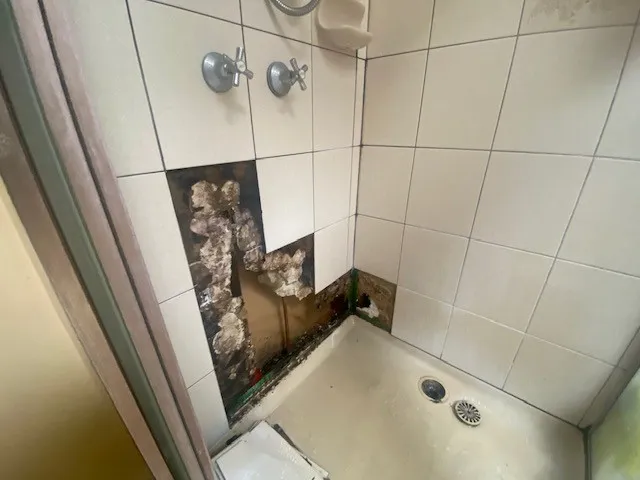
Silicone that repeatedly splits, peels, stays mouldy or separates from the same junction deserves a closer assessment. Possible contributors include movement between surfaces, trapped or recurring moisture, an unsuitable joint detail, loss of support, or failure in a concealed part of the shower system.
The correct scope depends on the failed layer. A specialist assessment can compare the joint with movement, moisture, drainage and surrounding damage before recommending maintenance, targeted work or a rebuild.
- The new silicone fails again unusually quickly.
- Cracks open as the shower base or adjoining tiles move.
- The joint stays wet, stained or mouldy despite normal cleaning and drying.
- Water damage, loose tiles, swelling or dampness appears outside the shower.