Shower Problems
What Is Epoxy Grout? Do I Need It in My Shower?
Compare epoxy and cement grout, where each can suit a shower, and why new grout cannot repair failed waterproofing or concealed damage.

What is epoxy grout?
Epoxy grout is made from epoxy resins and a hardener, often with a mineral filler. Once cured, it forms a dense, low-absorption joint between tiles. It is generally more resistant to staining and many chemicals than cement-based grout, which can make it useful in demanding wet or high-use areas.
That performance does not make epoxy grout a waterproofing membrane. In a shower, the membrane, substrate, waterstops, falls, drainage details, tile adhesive, grout and flexible sealant all have different jobs. Grout is the visible joint finish; it cannot replace a failed layer behind the tiles.
Epoxy grout versus cement grout
Cement-based grout is the familiar powder product mixed with water or an approved additive. It is usually easier and less expensive to install, offers a broad colour range and is suitable for many domestic bathrooms when the product, joint size and installation method match the tile system.
Epoxy grout has much lower water absorption and is generally more stain and chemical resistant. It also costs more, has a shorter and less forgiving working process, and requires careful cleaning during professional installation to avoid residue on the tile face.
- Cement grout: economical, widely used and appropriate for many correctly built domestic showers.
- Epoxy grout: dense, durable and useful where low absorption or greater stain resistance is important.
- Neither product: a substitute for waterproofing, sound substrates, correct drainage or flexible silicone at movement joints.
When can epoxy grout be a suitable choice?
Epoxy grout can be a sensible specification for commercial bathrooms, public amenities, swimming-pool surrounds and other high-use tiled areas where frequent cleaning and stain resistance matter. It can also be selected for a new domestic shower when the tile is compatible, the appearance is preferred and the added material and labour cost is justified.
For many homes, a quality cement-based grout remains a reasonable choice. The decision should be made as part of the complete tile and waterproofing specification—not as an isolated promise that a shower will never leak.
What epoxy grout cannot fix
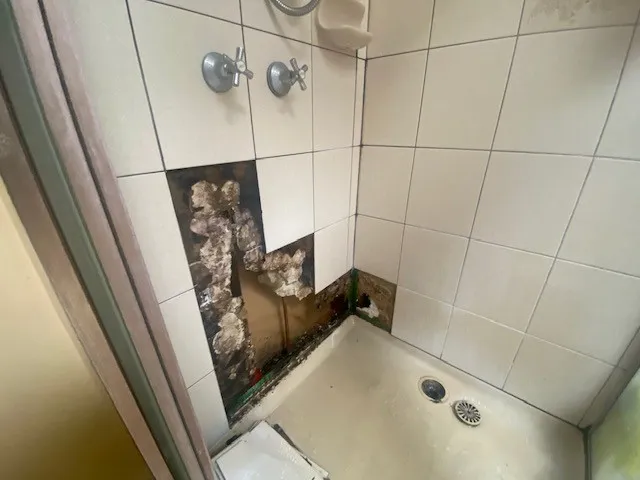
Applying epoxy grout over a shower with failed waterproofing, wet or damaged substrate, loose tiles, movement, poor falls or a drainage defect does not repair the failed part of the system. A stronger surface joint may still crack or separate if the structure underneath moves, and it can leave concealed moisture damage unaddressed.
The same caution applies to repeated regrouting. Renewing worn surface material can be valid maintenance when the layers below are sound, but it should not be presented as a leak repair without first establishing where water is escaping and why.
Cleaning and maintenance
Follow the grout and tile manufacturers’ care instructions. In general, routine cleaning with warm water, a soft cloth or non-scratch pad, and a mild pH-neutral cleaner is safer than abrasive tools or strong acidic and alkaline products. Rinse residues and keep the shower ventilated so surfaces can dry.
Epoxy grout is easier to keep clean because of its low absorption, but it is not maintenance-free. Soap residue and surface mould can still collect on top. Silicone joints should also be watched separately: silicone remains the flexible seal at corners and junctions and can age even when the grout is sound.
Signs the problem may be deeper than grout
A single discoloured joint does not diagnose a failed shower. However, recurring or widespread symptoms are a reason to stop choosing products and assess the complete system.
- Grout repeatedly cracks, softens or falls out after earlier surface work.
- Tiles sound hollow, move, lift or crack.
- Silicone repeatedly separates at corners or around the screen.
- Water appears outside the shower, in adjoining rooms or on the ceiling below.
- Skirting, plaster or flooring swells, stains or develops a persistent musty smell.
- The base flexes, water pools, or drainage is noticeably slow.
Discuss shower rectification before deciding
The useful question is not only “Which grout is stronger?” It is “Which layer has failed, if any?” A shower assessment can compare the grout and silicone condition with movement, moisture evidence, drainage and the surrounding building finishes.
Our shower visit provides a visual assessment of accessible areas, consultation and a rectification quotation. Select the shower assessment appointment in the shared booking form.